


























0
Views
0
Downloads

0.0
0
Save
0 Likes
Share
Explore Shades of Meaning with This Chart Worksheet
0 Views
0 Downloads
Paste this activity's link or code into your existing LMS (Google Classroom, Canvas, Teams, Schoology, Moodle, etc.).
Students can open and work on the activity right away, with no student login required.
You'll still be able to track student progress and results from your teacher account.
Information
Description
What It Is:
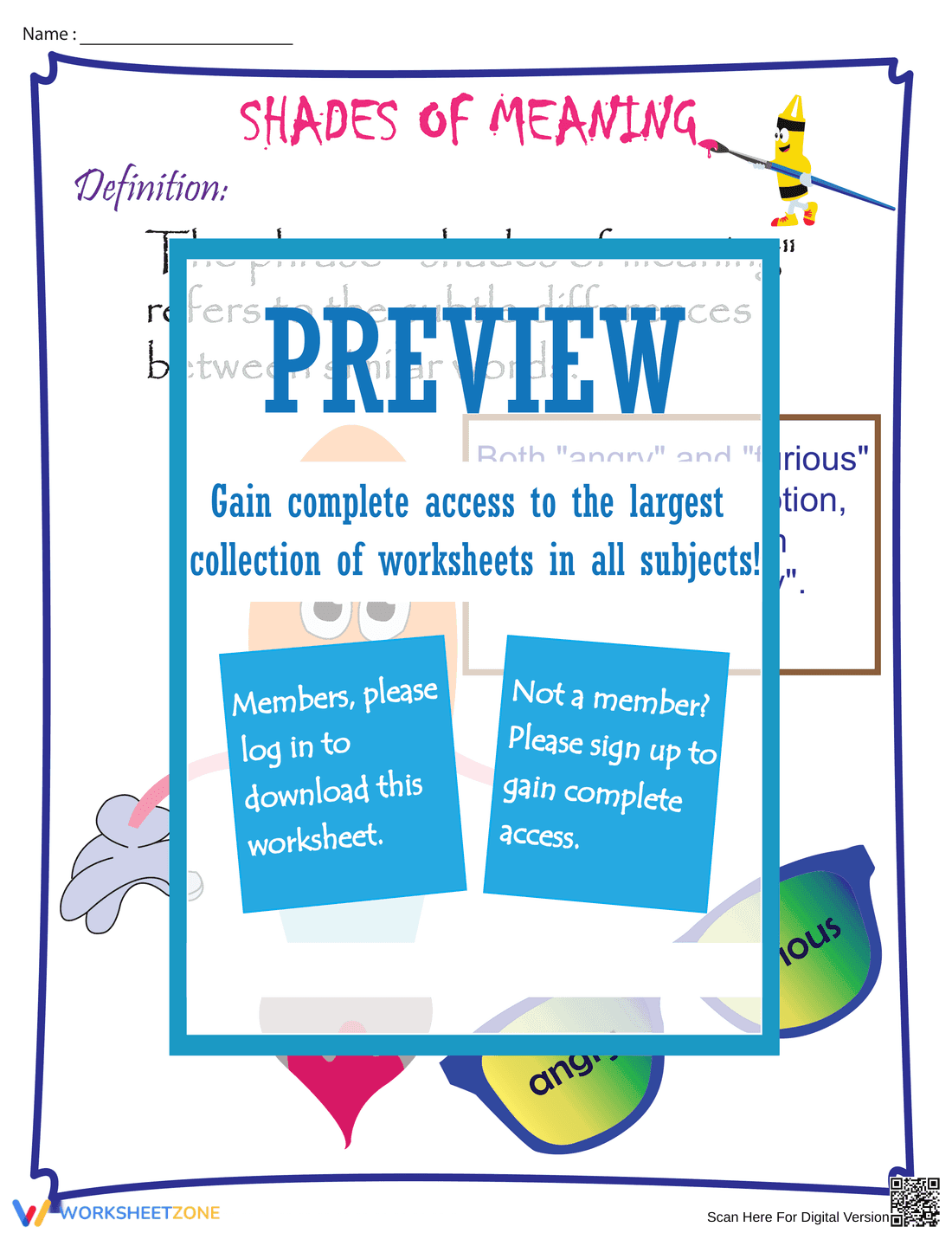
This is an educational worksheet focusing on 'shades of meaning,' which are the subtle differences between similar words. The worksheet provides a definition of the phrase 'shades of meaning' and gives an example using the words 'angry' and 'furious,' explaining that 'furious' is a stronger emotion than 'angry.' The worksheet features cartoon graphics, including a paintbrush character and sunglasses with the words 'angry' and 'furious' displayed on the lenses.
Grade Level Suitability:
This worksheet is suitable for grades 2-4. The concept of shades of meaning requires a basic understanding of vocabulary, and the example provided is straightforward and easy to understand for this age range. The visual aids also make it engaging for younger learners.
Why Use It:
This worksheet helps students expand their vocabulary and understand the nuances of language. It encourages critical thinking about word choice and how different words can convey varying degrees of intensity or meaning. It promotes better communication skills by enabling students to select the most appropriate word to express themselves.
How to Use It:
Begin by reviewing the definition of 'shades of meaning' with students. Discuss the example provided, explaining how 'furious' is a stronger word than 'angry.' You can then ask students to provide other examples of words with similar meanings but different intensities. The worksheet can be used as an introduction to a broader lesson on synonyms and antonyms.
Target Users:
This worksheet is ideal for elementary school students, particularly those in grades 2-4, who are learning about vocabulary, synonyms, and shades of meaning. It's also helpful for ESL/ELL students who need to expand their understanding of English vocabulary and improve their communication skills.
This is an educational worksheet focusing on 'shades of meaning,' which are the subtle differences between similar words. The worksheet provides a definition of the phrase 'shades of meaning' and gives an example using the words 'angry' and 'furious,' explaining that 'furious' is a stronger emotion than 'angry.' The worksheet features cartoon graphics, including a paintbrush character and sunglasses with the words 'angry' and 'furious' displayed on the lenses.
Grade Level Suitability:
This worksheet is suitable for grades 2-4. The concept of shades of meaning requires a basic understanding of vocabulary, and the example provided is straightforward and easy to understand for this age range. The visual aids also make it engaging for younger learners.
Why Use It:
This worksheet helps students expand their vocabulary and understand the nuances of language. It encourages critical thinking about word choice and how different words can convey varying degrees of intensity or meaning. It promotes better communication skills by enabling students to select the most appropriate word to express themselves.
How to Use It:
Begin by reviewing the definition of 'shades of meaning' with students. Discuss the example provided, explaining how 'furious' is a stronger word than 'angry.' You can then ask students to provide other examples of words with similar meanings but different intensities. The worksheet can be used as an introduction to a broader lesson on synonyms and antonyms.
Target Users:
This worksheet is ideal for elementary school students, particularly those in grades 2-4, who are learning about vocabulary, synonyms, and shades of meaning. It's also helpful for ESL/ELL students who need to expand their understanding of English vocabulary and improve their communication skills.


